

The Qurʾān is believed by Muslims to have been revealed to the Prophet Muḥammad over the course of roughly two decades from 610 to 632 CE. The scripture is considered to have been preserved both orally - through the meticulous memorisation of the text - and in written form. While the Prophet is reported to have dictated the text to scribes, the traditional sources nonetheless indicate that the Qurʾān was not compiled in the form of a codex (muṣḥaf) during the lifetime of the Prophet. Instead, it was compiled during the reign of the Prophet's successor Abū Bakr [632 - 634] and officially standardised during the reign of the third caliph ʿUthmān b. ʿAffān [644 – 656]. All modern copies of the Qurʾān trace back to the original codices prepared during ʿUthmān's reign.
How reliable is the traditional narrative presented above? This article aims to answer this question in three parts. The first part of this article will present evidence that affirms the historicity of the standardisation of the Qurʾān by ʿUthmān. This section shall show that the Qurʾān we have today faithfully preserves the rasm (i.e. the undotted text) of the codices prepared by ʿUthmān. Even if the Qurʾān remained unchanged after the time of ʿUthmān, can the same be said for the period between the Prophet's death and ʿUthmān's reign? This question is addressed in the second part of this article, where I shall present evidence that strongly suggests that the Uthmanic text preserves the basic wording of the Prophet's revelations. Finally, the third part of this article will discuss the transmission of the Qurʾān after ʿUthmān. I shall argue that the existence of variant readings can be justified with reference to the seven aḥruf ḥadīths, which suggest that the Prophet Muḥammad approved of some flexibility in the recitation of the Qurʾān as long as the basic meaning of the verses is preserved.
The majority of scholars affirm that the Qurʾān was likely fixed by the mid 7th century based on the following evidence:
Several Qurʾān manuscripts can be dated to the 1st/7th century. Some of these have even been radio-carbondated to within two or three decades of the Prophet's death. These include the famous Birmingham manuscript (C14: 568–645 CE), Codex DAM 01-25.1 (C14: 543–643 CE) and Ms Qāf 47 (C14: 606–652 CE). Caution is still necessary, however, as some scholars have expressed concerns about the reliability of radio-carbon dating.
Nonetheless, even if we set aside radiocarbon dating, we can still date most of these manuscripts to before ʿAbd al-Malik's reign. The earliest manuscripts are generally written in the ḥijāzī script, which is known for its slanting of the letters (and alif in particular) to the right. The shapes of letters also vary considerably from one scribe to another, and even a single scribe may write the same letter in different ways. This is quite different from manuscripts written in “Kufic” scripts, where the letter shapes are much more regular. Some Qurʾānic manuscripts are written in calligraphy styles which are quite similar to the ones used in the Dome of the Rock [1] as well as two Qurʾānic inscriptions from Makkah dated to 80 AH (see here and here).
This allows us to establish a rough chronology of the scripts used to write the Qurʾān. As the ḥijāzī script is generally considered to be earlier than these Kufic scripts, it is quite likely that manuscripts written in the former script (generally) date to an earlier period.
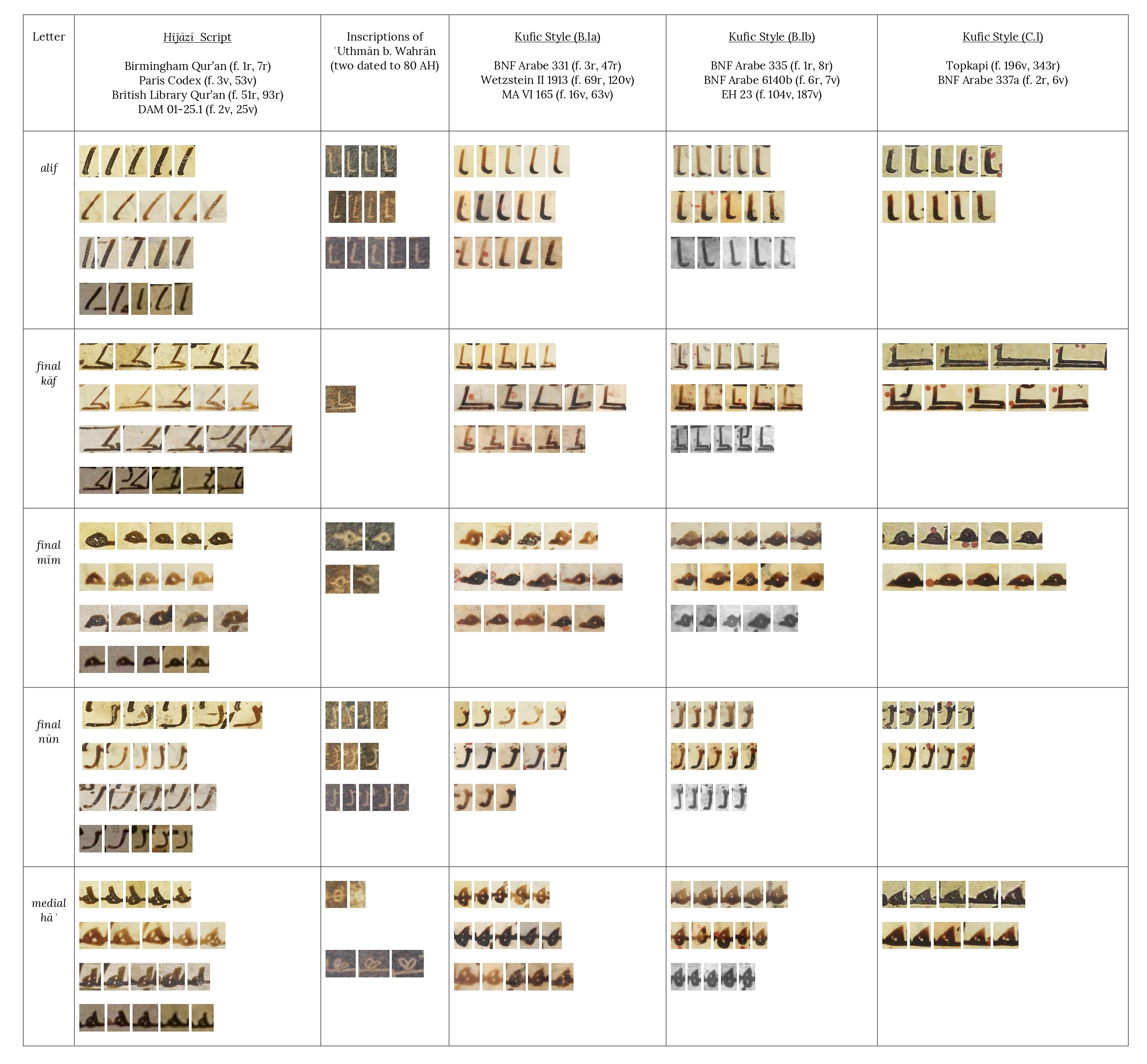
The manuscripts written in the ḥijāzī script also contain archaic spelling features. Most notably, the verb qāla is almost always spelled without an alif. The Kufic manuscripts, on the other hand, generally spell the verb with the alif. Thus, paleography (i.e. writing style), orthography (i.e. spelling features) and radio-carbon dating all point in the same direction: we have manuscripts of the Qurʾān that pre-date ʿAbd al-Malik's reign.
This is significant as some of these manuscripts attest a substantial portion of the Qurʾān. The Codex Parisino Petropolitanus and the British Library Qurʾān each contain 46 and 57 percent of the Qurʾān respectively. Marijn van Putten has also shown that these manuscripts (as well as several others) trace back to a common written exemplar. Considering how early some of these manuscripts are, he concludes that this evidence is perfectly consistent with the traditional account of ʿUthmān's canonisation.
The Qurʾān does not engage with the political and theological disputes that affected the Muslim community after the death of the Prophet Muḥammad. As several scholars have noted, this suggests that the text most likely already reached closure prior to these events. Nicolai Sinai, for instance, states:
If the Quranic rasm did not reach closure until c. 700, it does seem odd that it should nowhere engage with the major developments that defined Islamic history between 630 and 700, in particular the unprecedented speed with which an alliance of “barbarian” tribes from the fringes of the Byzantine and Sasanian empires established themselves as the masters of an immense territory, and the bitter disputes and civil wars that soon wreaked havoc on the unity of the conquerors
Everyone agreed that ʿUthmān was responsible for uniting the Muslims upon one standard Qurʾān. Muslims from different parts of the empire with varying political and theological commitments traced the text to ʿUthmān. As Behnam Sadeghi notes, the fact that the Islamic tradition does not preserve any traces of dissenting views on this suggests that we are dealing with a genuine memory of a historical event:
It is not possible to envision an Umayyad caliph establishing the standard version. To assume so would require explaining not only how the Umayyads managed to erase their empire-wide intervention from the memories of their subjects, whose statements have reached us in large numbers, in various cities, tribes, and sects, but also how it was possible to induce the same false memory about ʿUt̠mān among all, including the dissidents who preferred ʿAlī to ʿUt̠mān.
In the previous section, we discussed the evidence in favour of the historicity of ʿUthmān's standardisation. The traditional sources inform us that ʿUthmān felt compelled to standardize the Qurʾān as Muslims from different parts of the empire disagreed with one another concerning its recitation. What led to this variation? One possible source is the Prophet Muḥammad himself reciting the Qurʾān in different ways. This view would appear to be supported by a group of ḥadiths which assert that the Qurʾān was revealed in seven "modes" (aḥruf):
Various interpretations have been put forward regarding the meaning of the term seven aḥruf. One common interpretation is that they refer to seven dialects, but this explanation would appear to be challenged by the fact that both ʿUmar and Hishām spoke the same dialect.6 Moreover, many of the variant readings attributed to Companions cannot be explained as dialectical variation. An alternative view would be to view the aḥruf as a divine concession allowing for some flexibility in the recitation of the Qurʾān - especially for those who find it difficult to recite or memorise the text. This view finds some support in the early Islamic tradition. Ibn Masʿūd, for instance, is reported to have stated:
Regardless of how we interpret the seven aḥruf hadiths, it seems quite likely that there may have existed some flexibility in the transmission of the text during the Prophet's lifetime and shortly after. Nonetheless, we should not exaggerate the extent of this flexibility. There are, in fact, good reasons to believe that the Uthmanic text faithfully preserves the structure and basic wording of the "original" revelations.
The lower text of the Ṣanʿāʾ Palimpsest, which could represent a codex of one of the Prophet’s Companions, offers valuable insight into the early history of the Qurʾān. The manuscript has undergone radiocarbon dating several times, the results of which seem to suggest that it was produced before 650 CE. Even if the manuscript were written as late as 690 CE, hypothetically speaking, it could still represent an older tradition that pre-dates 650 CE.8
Unlike all other known Qur'anic manuscripts, the lower text differs from the Uthmanic text in two ways: (1) the wording of the verses and (2) the arrangement of chapters. Nonetheless, it agrees with the Uthmanic text as far as the structure of each chapter is concerned. A sample portion of the lower text containing Q. 9:123-9 is presented in the table below.9 Not only does the lower text preserve the same verse order, but its wording also closely corresponds to that of the Uthmanic text.
| Uthmanic Text | Ṣanʿāʾ Lower Text |
|---|---|
| يأيها الذين آمنوا قتلوا الذين يلونكم من الكفر وليجدوا فيكم غلظة واعلموا أن الله مع المتقين وإذا ما أنزلت سورة فمنهم من يقول أيكم زادته هذه إيمنا فأما الذين آمنوا فزادتهم إيمنا وهم يستبشرون وأما الذين في قلوبهم مرض فزادتهم رجسا إلى رجسهم وماتوا وهم فسقون أولا يرون أنهم يفتنون في كل عام مرة أو مرتين ثم لا يتوبون ولا هم يذكرون وإذا ما أنزلت سورة نظر بعضهم إلى بعض هل يرىكم من أحد ثم انصرفوا صرف الله قلوبهم بأنهم قوم لا يفقهون لقد جاكم رسول من أنفسكم عزيز عليه ما عنتم حريص عليكم بالمومنين روف رحيم فإن تولوا فقل حسبي الله لا إله إلا هو عليه توكلت وهو رب العرش العظيم | يأيها الذين آمنوا قتلوا الذين يلونكم من الكفر وليجدوا فيكم غلظة واعلموا أن الله مع المتقين وإذا أنزلت سورة فمنهم من يقول أيكم زادته هذه إيمنا فأما الذين آمنوا فزادتهم إيمنا وهم يستبشرون وأما الذين في قلوبهم رجس فزدتهم رجزا إلى رجسهم وماتوا وهم كفرون أولا يرو أنهم يفتنون في كل عام مرة أو مرتين ثم لا يتوبون ولا يتذكرون وإذا أنزلت سورة نظر بعضهم إلى بعض هل يرىنا من أحد فانصرفوا فصرف الله قلوبهم ذلك بأنهم قوم لا يفقهون ولقد جاكم رسول منكم عزيز عليه ما عنتكم حريص عليكم بالمومنين روف رحيم فإن تولوا عنك فقل حسبي الله الذي لا إله إلا هو عليه توكلت رب العرش العظيم |
There are still several variations, but most do not have any significant impact on the meaning of the verse. In some cases, it is plausible that the scribe’s memory may have been influenced by other parts of the Qurʾān. For instance, at v. 125, the lower text reads wa-mātū wa-hum fāsiqūn ("And they died while they were defiant") instead of wa-mātū wa-hum kāfirūn ("And they died while they were disbelievers"). The former phrase appears in v. 84 (in both the Uthmanic and lower text) and thus the scribe may have had that verse in mind when he wrote v. 125. This phenomenon – known as the assimilation of parallels – occurs quite frequently in the lower text and other companion codices.
The lower text, as well as other companion codices, allow us to make some tentative conclusions regarding the early history of the Qurʾān. As these codices generally have the same passages within the surahs (with minor variations in wording), Behnam Sadeghi and Mohsen Goudarzi argue that “the existing pieces of revelation were joined to form the sūras prior to ‘Uthmān’s famous and fairly effective attempt to standardize the text.”.11 In other words, the surahs were likely fixed before ʿUthmān‘s standardisation. The authors note that this supports the traditional view that this had already occurred during the Prophet’s lifetime.12 What remained slightly fluid, then, was the precise wording of the revelations.
Based on the close similarities between the Uthmanic text and the companion codices (including the lower text), Sadeghi and Goudarzi have suggested that the different traditions may have arisen when the Prophet (or his Companions) dictated the text to scribes.13 They further note that whenever disagreements occur between the lower text, Ibn Masʿūd’s codex and the Uthmanic text, the latter is usually in the majority position.14 Some caution is necessary here, as these conclusions are only based on a portion of the extant folios of the palimpsest. Nevertheless, these observations invite us to seriously consider the possibility that the Uthmanic text is a more faithful transcription of the Prophet’s revelations than the other (known) companion codices.
The codices prepared during ʿUthmān's reign contained very few diacritical marks and no vocalisation. Thus, at some places, they could be read in more than one way. A qirāʾah (pl. qirāʾāt) refers to a specific way of vocalising the entire Uthmanic codex. Most modern Muslim scholars generally accept the authenticity of ten qirāʾāt, each attributed to a prominent reciter who lived between the 1st and 3rd centuries.
Most of the variations in the qirāʾāt concern linguistic principles which can be applied throughout the Qurʾān and have no effect on the meaning. Others concern disagreements at specific points in the Qurʾān and often do impact the meaning of the verse slightly. Some examples of variants of the latter type are given below15:
1. At Q. 1:4, four of the ten reciters read: maliki yawmi l-dīn (“king of the day of judgement”) while the remaining six reciters read: māliki yawmi l- dīn (“master of the day of judgement”).
2. At Q. 18:26, one reciter read: wa-lā tushrik fī ḥukmihi aḥadan (And do not ascribe any partners in His authority) while the other 9 readers read: wa-lā yushriku fī ḥukmihi aḥadan (And He does not share His authority with anyone).
3. At Q. 43:19, four of the reciters read : wa-jaʿalū l-malāʾikata lladhīna hum ʿinda l-raḥmāni ināthan (“And they made the angels, who are with the Most Merciful, females”), while the remaining six readers recited: wa-jaʿalū l malāʾikata lladhīna hum ʿibādu l-raḥmāni ināthan (“And they made the angels, who are servants of the Most Merciful, females”)
The ten reciters nonetheless recite the majority of the Qurʾān in the same way. In fact, these reciters often agree with one another at places where an alternative reading of the Uthmanic rasm is possible. This strongly suggests that the reciters were relying upon a shared oral tradition. In a recent article, Hythem Sidky has further developed this line of reasoning by examining ten such cases. He observes that the reciters' agreement cannot be the result of written transmission as early manuscripts are usually left undotted at these places - or if they do contain dots, they sometimes attest the alternative non-canonical variant! The fact that the ten reciters agreed with one another, therefore, is highly significant:
Manuscript examination also confirms that written transmission was not responsible for this common core. Therefore, this common core must have been transmitted by way of a living oral tradition parallel to the written text. In other words the reading traditions are not exclusively the result of independent attempts to decipher the undotted skeletal text of the Quran
How early can we date the shared oral tradition? As one of the canonical readers (Abū Jaʿfar) is reported to have already been teaching the Qurʾān prior to the battle of Ḥarrah in 63/683, Sidky dates the oral tradition to "no later than the middle of the first/seventh century". If one is more sceptical of such reports, however, then the latest possible date for the oral tradition would be the late 1st/7th century. It is possible that the oral tradition is actually a common memory of how the Prophet Muḥammad himself recited the Qurʾān. This shared memory of the Prophet's recitation may have been adapted slightly to fit the Uthmanic rasm.
To summarise, the ten readers agree with one another regarding the vocalisation of the majority of the Qurʾān. This agreement likely traces back to a shared oral tradition which likely dates to the mid 7th century (if not earlier). But what about the disagreements amongst the reciters? Most Western scholars have suggested that these variations arose later in the 1st/7th century, due to transmission errors, grammatical/exegetical concerns and/or attempting to read an ambiguous written text. According to the dominant Sunni traditional perspective, on the other hand, even these variations trace back to the Prophet Muḥammad. This is difficult to prove, however.
Another issue concerns variants in the rasm itself. The codices that ʿUthmān dispatched to the different provinces were not identical. There were roughly 40 minor variations between them, mostly involving the addition/omission of a single letter.17 For instance, at Q. 2:116, the Syrian codex read: qālū ttakhada llāhu waladan (“They said: Allāh has begotten a child”) omitting the conjunction wāw (“and”) which was present at the start of the verse in all other codices. This variant – along with the other 40 rasm variants in the original Uthmanic codices – survives in the canonical readings. Traditional scholars generally assume that these 40 variations were intentionally included in the Uthmanic codices. While this interpretation is possible, it seems hard to imagine considering how insignificant they are.
How should we interpret these issues? One approach is to accept that all of the variations discussed above were explicitly taught or approved by the Prophet, even if that may seem unusual and difficult to establish from a historical perspective. This is not an unreasonable position; however, I believe the evidence is better explained in an alternative manner. As discussed earlier, some early Muslims appear to have accepted a limited degree of flexibility in the recitation of the Qurʾān. It is plausible that the Prophet himself approved of such flexibility, particularly for those who were finding it difficult to memorise the text. Even highly skilled modern reciters occasionally find themselves confusing verses with other parts of the Qurʾān. This issue would likely have been even more pronounced during the Prophet’s lifetime when most converts were relatively advanced in age, and written codices were likely not widely available for quick verification.
The revelation of the Qurʾān in seven aḥruf was the solution to this problem. It is quite telling that the only ḥadīths that hint at the type of variation encompassed by the seven aḥruf make reference to the substitution of one verse ending with another. A ḥadīth on the authority of Abū Hurayrah has the Prophet simply state: “The Qurʾān was revealed in seven aḥruf, ʿalīman ḥakīman, ghafūran raḥīman.”18 Another ḥadīth, on the authority of Ubayy b. Kaʿb, ends with the Prophet saying: “Nothing is from it, except that it is pure and complete – if you said ghafūran raḥīman or samīʿan ʿalīman. As long as you do not conclude a verse of punishment with mercy, or a verse of mercy with punishment.”19 We had seen earlier that Ibn Masʿūd justified a limited degree of flexibility in recitation using similar language. The idea also appears in some ḥadīths which narrate the story of a scribe of the Prophet who left Islam because he was allegedly given the freedom to choose between samīʿan baṣīran and ʿalīman ḥakīman.20 Thus, verbatim memorisation and preservation may not have been a major concern for the earliest Muslims. As long as the basic structure and message of the verses were left intact, it is possible that the Prophet and his Companions may have overlooked slight variations in wording. The position outlined here is quite similar to the “Divine Permission” model recently advocated by Yasir Qadhi:
Qadhi notes that several Muslim scholars appear to have held this position as well. Ibn Shihāb al-Zuhrī and Yaḥyā b. Saʿīd al-Qaṭṭān, for instance, argued that transmitting ḥadīths with slight variations in wording was permissible since a similar concession was made for the Qurʾān despite its greater sanctity.22 It is important to note here that this model does not imply that people had the freedom to change the wording of the revelations as they wished. Several early traditions explicitly urge us to recite in the way we were taught.23 The two positions are not mutually exclusive. It is likely that the early Muslims strove to preserve the Prophet‘s revelations as accurately as they could. But when differences did arise, they may have been overlooked – assuming they did not significantly impact the meaning of the passages.
Q. 15:9 states that Allāh will preserve the "Reminder” (al-dhikr) that He has sent down. Classical scholars often interpreted this verse as a divine promise to protect the Qurʾān from manipulations by devils.24 This is certainly a plausible interpretation. In verse 6 of this chapter, we learn that the Prophet's opponents mockingly refer to him as ”the one who the Reminder has been sent down to” (alladhī nuzzila ʿalayhi l-dhikr) only to accuse him of being possessed by a jinn (majnūn). In verse 7, they ask him why he does not bring angels to them instead. Verse 9 may be a reassurance to the Prophet that the transmission of the scripture from Allāh to His Prophet was secure. In other words, the central issue here was the process of revelation to the Prophet, not the transmission of the Qurʾān after the revelation. Of course, Allāh's promise to protect His scripture would extend to both periods but the point that I wish to make is that the passage is concerned with malicious distortion of the text. It is not necessarily a promise to preserve every single letter and sound of the prophetic revelation.
In my opinion, this interpretation of the passage is consistent with the early transmission of the Qurʾān. There is no evidence that politically or theologically motivated changes were made to the Qurʾān after the Prophet's death. In fact, as we had seen earlier, the silence of the Qurʾān on issues that affected the early Muslim community after the Prophet's death is often taken as evidence that the text was closed at a very early date. While the latest possible date for this closure is the reign of ʿUthmān, the lower text of the Ṣanʿāʾ Palimpsest and other companion codices allow us to go even further. It is quite likely that the surahs were already fixed during the lifetime of the Prophet, though a limited amount of flexibility in recitation allowed for the proliferation of minor variations. This flexibility was constrained in two ways. Firstly, the Qurʾān was already transmitted in writing during the Prophet’s time. Secondly, the early Muslims strove to memorise the text as accurately as possible. Nonetheless, when minor variations did arise, they were overlooked as long as the meaning and basic structure of the passages was preserved.
[1] Déroche, Qur’ans of the Umayyads (Leiden 2014), p. 80
[2] Marijn van Putten, “The Grace of God” as evidence for a written Uthmanic archetype: the importance of shared orthographic idiosyncrasies”
[3] Nicolai Sinai, When did the consonantal skeleton of the Quran reach closure? Part II, Bulletinof the School of Oriental and African Studies, 7-8
[4] Behnam Sadeghi and Uwe Bergmann, The Codex of a Companion of the Prophet and the Qurʾān of the Prophet, Arabica 57, 2010, 343–436, p. 366
[5] ʿAbd al-Razzāq, Muṣannaf, ed. Ḥabīb al-Raḥmān al-Aʿẓamī, 11 vols, Beirut: al-Majlis al-ʿIlmī (1983), 11/218-219
[6] Yasin Dutton, Orality, Literacy and the Seven Aḥruf Ḥadīth, Journal of Islamic Studies, 23/1 (2012), 1-49, p. 24
[7] ʿAbd al-Razzāq, Muṣannaf, 3/364; Abū ʿUbayd, Kitāb Faḍāʾil al-Qurʾān, ed. Marwan al-ʿAtiyyah, Muḥsin Kharābah and Wafāʾ Taqī al-Dīn, Damascus: Dār Ibn Kathīr (1995), p. 355; Abū Yūsuf, Kitāb al-Āthār, p. 44; al-Bayhaqī, Shuʿab al-Īmān, ed. Zaghlūl, 9 vols, Beirut: Dār al-Kutub al-ʿIlmiyyah (2000), 2/422. The common link of the report is Ibrāhīm al-Nakhaʿī (d. 96/714), who transmitted it to two of his students: Ḥammād b. Abī Sulaymān (d. 738) and al-Aʿmash (d. 148/765). In all versions other than that of al-Bayhaqī, al-Nakhaʿī simply states that ʿAbd Allāh (ibn Masʿūd) said it. While al-Nakhaʿī is a well-known authority concerning Ibn Masʿūd's traditions, he did not learn directly from him. Thus, the original isnād was probably disconnected. Nonetheless, several scholars considered the mursal narrations of al-Nakhaʿī from Ibn Masʿūd to be authentic. Irregardless of whether the narration traces to Ibn Masʿūd, it is relatively clear evidence that major scholars in the 1st/7th century considered it permissible to recite with a limited amount of flexibility.
[8] Behnam Sadeghi and Mohsen Goudarzi, Ṣan‘ā’ 1 and the Origins of the Qur’ān, p. 18. This suggestion gains additional plausibility in light of Élénore Cellard’s finding that the lower text was written by at least two scribes who sometimes alternated within a single verse – a feature which indicates that the manuscript was likely copied from an earlier written copy. See Cellard, The Ṣanʿāʾ Palimpsest: Materializing the Codices, Journal of Near Eastern Studies 80 no. 1 (2021), p. 8
[9] I have relied on the transcription of this portion found in Sadeghi and Goudarzi, Ṣan‘ā’ 1 and the Origins of the Qur’ān, p. 62-3. The manuscript mostly lacks diacritics and a few individual letters are less clear than others. Nonetheless, the consonantal skeleton of the text of the text given above is easily discernable.
[10] ibid, p. 20
[11] ibid, p. 8. See also p. 23: “It follows from the fact that the ‘Uthmānic Qur’ān, C-1, and the Companion codices generally have the same passages within the sūras, that the sūras were fixed before these various textual traditions branched off, in particular before the spread of the ‘Uthmānic version. (emphasis mine)”.
[12] ibid, p. 22-23
[13] ibid, p. 26: “As mentioned above, most of the differences between C-1 and the other text types must have arisen at the branching off of the textual traditions. This happened probably as the Prophet recited the text and a Companion wrote it down.”
[14] ibid, p. 21-22
[15] Ibn al-Jazarī, al-Nashr fī Qirā’āt al-ʿAshr, ed. ʿAlī Muḥammad al-Dabbāʿ, 2 vols, 2/368
[16] Hythem Sidky, Consonantal Dotting and the Oral Quran, Journal of the American Oriental Society (2023), 785-814, p. 809
[17] al-Dānī, al-Muqniʿ fī maʿrifat marsūm maṣāhif al-amṣār, ed. Riyadh: Dār al Tadmuriyyah (2010), p. 571-615. See also Hythem Sidky, On the Regionality of Qurʾānic Codices, JIQSA (2020): 133-210
[18] Ibn Ḥanbal, Musnad, ed. Shuʿayb al-Arnaut, Beirut: Muʾassasat al-Risāla, 50 vols (1421) 15/424; al-Nasāʾī, Sunan al-Kubrā, ed. Hasan al-Munʿim, Beirut: Muʾassasat al Risāla (2001), 7/289; al-Ṭabarī, Jāmiʿ al-Bayān ʿan taʾwīl āy al-Qurʾān, ed. ʿAbd Allāh Ibn ʿAbd al-Muḥsin al-Turki, Cairo: Dār Hajar (2001), 26 vols, 1/21
[19] ʿAbd al-Razzāq, Muṣannaf, 11/219-220; Ibn Ḥanbal, Musnad, 35/84-86; Abū Dāwūd, Sunan, ed. Muḥammad Muḥī al-Dīn ʿAbd al-Ḥamīd, Beirut: al-Maktabah al ʿAṣriyyah, 4 vols, 2/76
[20] Ibn Ḥanbal, Musnad, 19/247, 21/194
[21] Yasir Qadhi, An Alternative Opinion on the Reality of the ‘Seven Aḥruf’ and Its Relationship with the Qirāʾāt, History of the Qurʾān: Approaches and Explorations, 221-281, p. 230
[22] ibid, p. 236-7
[23] Abū ʿUbayd, Kitāb Faḍāʾil al-Qurʾān, p. 361
[24] al-Ṭabarī, Jāmiʿ al-Bayān, 14/ 18-19 cites two narrations attributing this view to Qatādah. He mentions another interpretation which glosses the hāʾ as referring to the Prophet Muḥammad, i.e. God protects the Prophet from harm. This, however, is not very convincing. See also al-Bagahwī, Maʿālim al-Tanzīl, Riyadh: Dār al-Ṭībah (1991), 5 vols, 4/369-70.
© Mohammed Al-Firas